
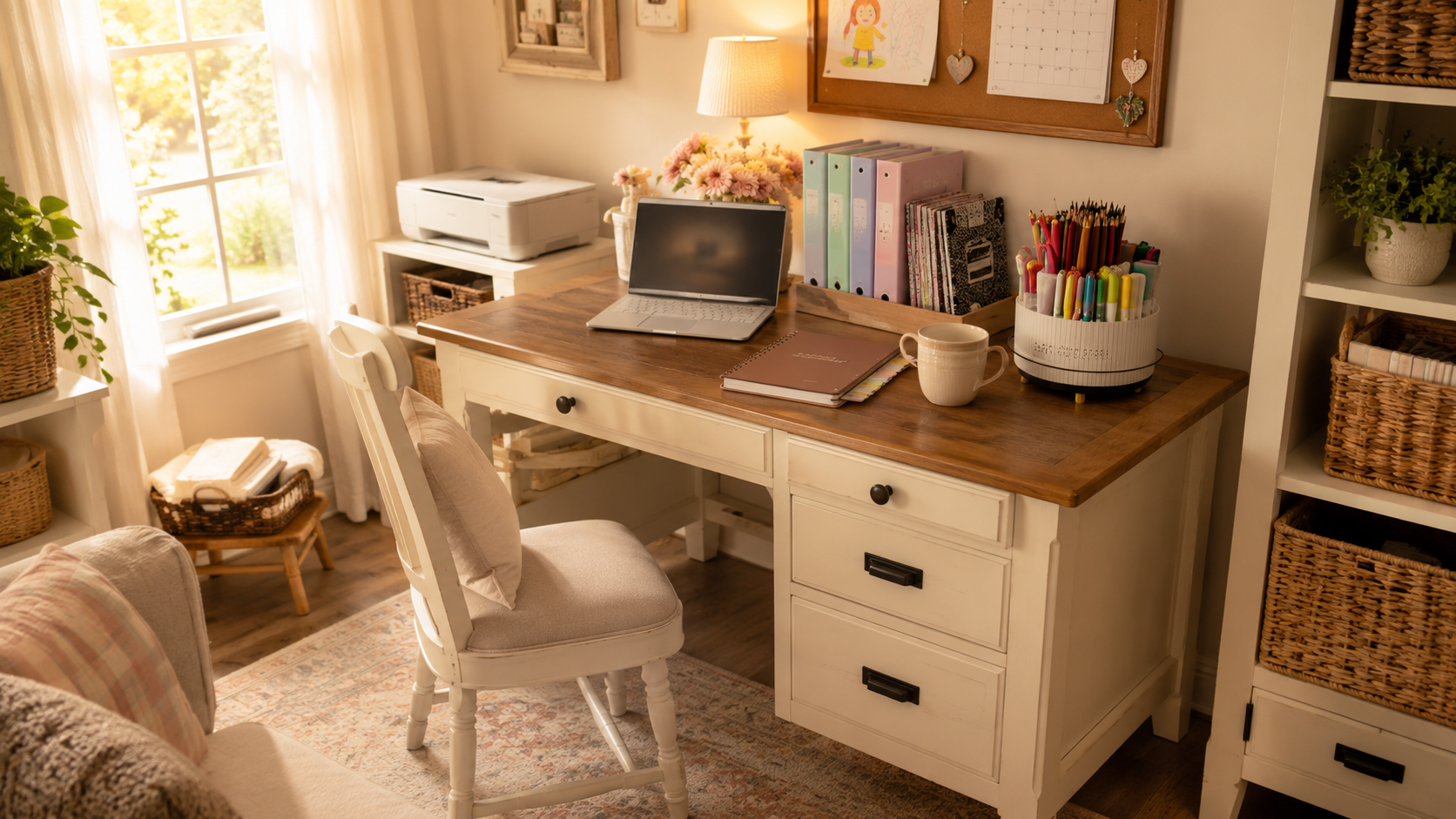
🌼 This isn’t a Pinterest-perfect homeschool room. It’s just what actually helps us get through the week.
I didn’t grow up homeschooling.
Homeschooling wasn’t something I had planned for. I didn’t have a vision for what it would look like or how to set it all up.
I just knew my kids needed something different—and I figured it out as I went.
With a back injury I’m still working through, a one-year-old who has zero interest in slowing down, and three kids fourteen years apart — this homeschool has to work around real life.
And it does.
So this list isn’t perfect.
It’s just what we actually use.
What sits on our desk, what gets pulled out every single week, and what makes homeschooling three kids at three completely different stages feel a little more manageable.
If you’re just starting out, or you’re trying to figure out what you actually need versus what looks good on a shelf — I hope this helps.
→ Why We Chose Homeschooling When I Wasn’t Sure I Could Do It
The Workspace
We have one desk.
One chair.
And two kids who take turns at it.
It works.
A shared desk and chair
You don’t need a whole homeschool room. One dedicated spot is enough — somewhere that signals to everyone that school is happening here.
Individual organizers
Each of my older kids has their own. Because apparently one borrowed pencil can start an all-out battle between a preteen girl and a teen boy.
A teacher planner (just for you)
Not for planning every minute — more for keeping track of writing prompts, what each kid is working on, and anything they need extra help with. If math isn’t clicking or a prompt is giving them trouble, I write it down so I can come back more prepared.
→ What Our Homeschool Days Actually Look Like
The Paper System
This is probably the thing I’m most proud of figuring out.
I build subject binders for each of my older kids — one for English, one for math.
Inside each binder are clear sleeve protectors with printed worksheets tucked inside. They don’t write on the sheet in the sleeve. I take it out, copy the page, and they work off that page.
That way, the original worksheet stays clean.
And I can reuse it again, whether it’s for future kids, review, or extra practice later on.
An all-in-one printer
Prints, copies, and scans. That’s all you need. I run mine constantly. At this point, it might be the hardest-working member of our homeschool.
Clear sleeve protectors
The secret to the whole binder system. Slide the worksheet in, take it out to copy, slide it back. The original never gets written on.
Three-ring binders
One per subject, per kid. Organized, easy to grab, easy to take on the road.
Composition notebooks
For day-to-day writing, note-taking, and story prompts. I grab a good stack at a time so we never run out.
A zippered travel binder
Holds whatever they’re working through that week. This goes with us everywhere — appointments, my nana’s assisted living facility, wherever the day takes us. It is basically our “school on the go” survival kit.
Core Knowledge Foundation
A free website with downloadable PDFs across subjects and grade levels that I print and slide right into our binder system. I come back to this one constantly. It has genuinely saved me so much time.
Keeping the Little One Busy
Homeschooling with a toddler in the house is its own whole thing.
What works for us is keeping it to one thing at a time.
Not everything out at once.
Just one.
Magnetic tiles
We all like to see how much we can build before he comes over and destroys it like a tiny tornado.
Mega blocks
Same idea. Simple, easy to dump out, and somehow still fun every single time. He stacks them, knocks them down, hands them to us, steals them back, and starts all over again.
Finger puppets
We have a set with different colored characters — he loves these.
A simple puzzle
Good for focus. Good for a few quiet minutes.
A toy tool box
He is obsessed with this one right now.
Flash cards
We rotate these in too — colors, shapes, animals. Early learning without it feeling like school.
The one-at-a-time rule is what makes this work. We pull out one thing, play until he’s done, put it away, then move to the next. He stays more interested. Cleanup stays manageable.
The Digital Side
Time4Learning
Our main curriculum.
It covers multiple subjects.
Lets each kid work at their own level and pace.
And gives me a structure to build the rest of our week around.
For us, it’s the backbone — everything else fills in around it.
Microsoft Family Safety
We set up a separate profile on the laptop for the kids that runs through Microsoft Family Safety. Only approved websites are accessible from their side.
It took a little time to set up once.
Now I don’t have to hover over them every single minute.
Beyond Time4Learning, here are the free sites we actually use and come back to:
Free Learning Websites We Use
Khan Academy
Free, covers everything from early elementary through high school, and tracks their progress. Both of my older kids use this at their own level.
Typing.com
Both kids use this. Typing is a real skill — and this makes practicing it feel less like a chore.
Cool Math 4 Kids
Good for the days when math is feeling like too much. Same practice, different energy.
Core Knowledge Foundation
Beyond the printable PDFs I use for our binders, I also come back to this site just to explore topics and find things I didn’t know I needed yet.
National Geographic Kids
My kids don’t have unsupervised access to YouTube, so finding sites with real educational videos I actually trust has been huge for us. National Geographic Kids is one of the best. Videos, games, facts about science, animals, and the world — and I never have to worry about what they’re watching.
Starfall
Great for early reading and phonics. I’m already thinking about this one for my youngest as he gets older. The free version has plenty to explore, and if you want access to everything, the parent membership is about $35 per year, which is surprisingly affordable.
NASA Space Place
If your kids are curious about space, this website is a gem. It has games, activities, videos, and easy-to-understand explanations that make learning about space really fun.
PBS Kids
Perfect for those slower afternoons when you want something educational without worrying about what they’ll click on next.
You Don’t Need a Perfect Setup
Our homeschool doesn’t look like the ones on Instagram.
We have a shared desk, a printer that gets the job done, a binder system I built myself, and a toddler who is usually somewhere in the mix doing something with his magnetic tiles.
It is not perfect.
But it works.
And at the end of the day, that is the only thing that matters.
✨ Thank you for letting me share what’s actually working in our home right now.
If you’re homeschooling too, I’d love to hear — what’s one thing you couldn’t get through the week without?
With love,
Rachel (RaiRai 💛)
You might also enjoy:
→ Why We Chose Homeschooling When I Wasn’t Sure I Could Do It
→ What Our Homeschool Days Actually Look Like
→ The Version of Me I’m Still Becoming
This post is based on my personal experience homeschooling my own kids. Every family and every state has different requirements, so always check your own state’s current guidelines before making decisions about homeschooling.
This post may contain affiliate links. I only share products I personally use or have found genuinely helpful in our homeschool.


Leave a Reply